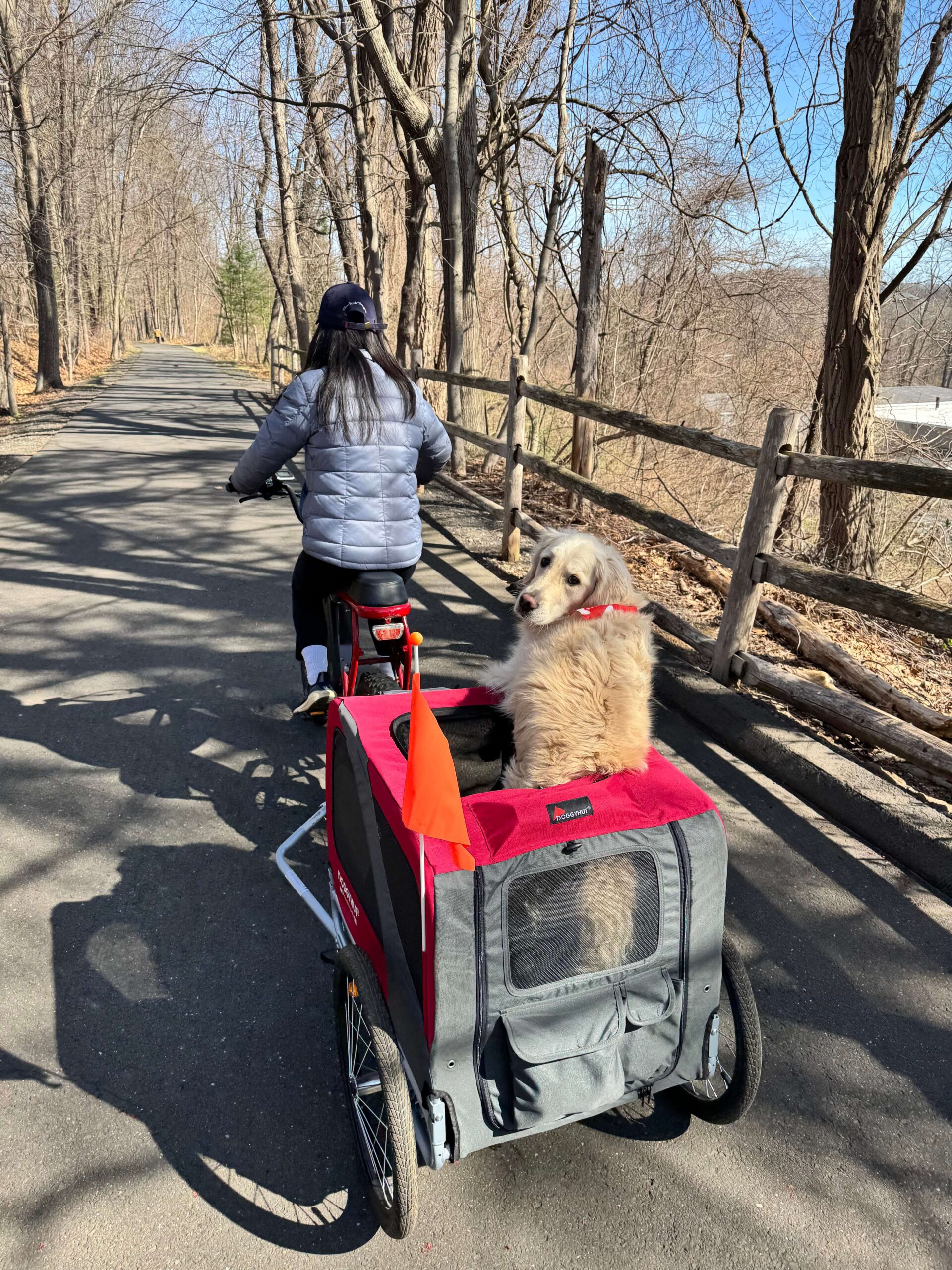
Last updated: July 2026. Written by Zoey, who has packed for a 65-lb golden retriever across road trips, ferries, and hotel stays in 15+ states.
What should you pack when traveling with a dog?
Pack five categories: food and water, health and ID documents, safety and restraint gear, sleep and comfort items, and cleanup supplies. For any trip longer than a weekend, bring 2–3 extra days of food, a copy of your dog’s vaccination records, and one item that smells like home. Everything else is trip-specific.
That’s the short answer. Below is the full checklist, plus what changes when you’re driving, taking a ferry, flying, or staying in a hotel — and the extra items that only matter if your dog is big.
in this guide
- The 12 non-negotiables
- Food and water
- Health, ID, and documents
- Safety and restraint
- Sleep and comfort
- Cleanup and grooming
- Add for a road trip
- Add for a ferry
- Add for flying (and the truth for big dogs)
- Add for hotels and rentals
- What changes when your dog is big
- Packing timeline
- FAQ
- Get the printable checklist
The 12 non-negotiables
These go in every bag, every trip, regardless of destination or duration.
| # | Item | Why it matters |
|---|---|---|
| 1 | Food, pre-portioned | Portioning by meal into bags prevents overfeeding and makes handoffs easy if someone else feeds your dog |
| 2 | Collapsible bowls (2) | One for food, one for water. Flat-packing bowls take almost no space |
| 3 | Water bottle with attached bowl | Rest stops and trailheads are unreliable. Assume no water is available |
| 4 | Leash + a spare | The spare is not optional. Leashes break, get soaked, and get left behind |
| 5 | Collar with current ID tag | Include your cell number, not your landline. Add “MICROCHIPPED” if applicable |
| 6 | Vaccination records | Digital copy on your phone AND a paper copy. Kennels, groomers, and some hotels ask |
| 7 | Waste bags (double what you think) | You will always use more than you planned |
| 8 | Bed or blanket from home | The single most effective anxiety tool. Familiar smell in an unfamiliar room |
| 9 | Towel | For paws, rain, lakes, mud, car seats, and hotel furniture |
| 10 | Basic first-aid supplies | Gauze, vet wrap, tweezers, antiseptic wipes, and any prescription medication |
| 11 | Current photo of your dog | If your dog goes missing in an unfamiliar place, you need a photo ready to show, not to search for |
| 12 | One favorite toy | Not the whole toy box. One item with a strong home association |
Food and water
Bring the entire trip’s food plus two to three extra days. Switching food mid-trip is the fastest route to an upset stomach in a hotel room, and your brand may not be sold at your destination.
- Pre-portioned meals in individual bags or a sectioned container
- Collapsible silicone bowls — two, so food and water are separate
- Insulated water bottle with a fold-out bowl for hikes and rest stops
- Water from home for the first day or two if your dog has a sensitive stomach — mineral content varies by region
- High-value training treats for recall in unfamiliar places and for rewarding calm behavior in hotels
- A long-lasting chew — the difference between a quiet dinner on a patio and a restless one
- A slow-feeder or lick mat if your dog eats anxiously in new environments
Health, ID, and documents
More than 35 states require some form of Certificate of Veterinary Inspection (CVI) for dogs entering from another state, and requirements vary by state, the dog’s age, and the purpose of travel (AVMA). USDA APHIS does not regulate owner-driven interstate pet travel — the destination state sets the rules (APHIS).
- Vaccination records — rabies certificate at minimum, digital and paper
- Certificate of Veterinary Inspection if your destination state requires one. These are typically valid for 10 days from issue and must come from a USDA-accredited veterinarian
- Microchip number written down somewhere that isn’t only your phone — and confirm the registry has your current phone number before you leave
- Prescription medications in original labeled containers, plus a few days’ buffer
- Flea, tick, and heartworm prevention on schedule — tick exposure changes significantly by region
- Your regular vet’s phone number and the address of a 24-hour emergency vet near your destination, looked up before you need it
- Pet insurance details if you carry it
Do this before you book: search the destination state’s agriculture department for its pet entry requirements. It takes five minutes and it is the one item on this list that can end a trip before it starts.
Safety and restraint
- Crash-tested harness or secured crate for the car — an unrestrained dog is a projectile in a collision and a hazard to the driver
- Standard 6-ft leash plus a spare
- Long line (15–30 ft) for beaches and open trails where off-leash isn’t permitted but you still want your dog to move
- Reflective or light-up collar accessory for early-morning and post-sunset walks
- Muzzle if your dog needs one, or if you’re visiting anywhere that requires it — introduce it at home first, never for the first time on a trip
- Paw protection — boots or paw wax for hot asphalt, ice, or salted roads
Sleep and comfort
The bed from home does more work than anything else you pack. A familiar smell in an unfamiliar room shortens the settling-in period from hours to minutes.
- Bed or blanket that already smells like home — do not wash it before the trip
- Crate or travel pen if your dog is crate-trained. Many hotels require dogs to be crated when left alone in the room
- One familiar toy
- A long-lasting chew for settling
- A calming aid if your dog uses one — talk to your vet before the trip, not during it
- A worn t-shirt of yours — free, weighs nothing, and works
Cleanup and grooming
- Waste bags — double your estimate
- Towels — at least two. One for paws, one for full-body
- Paw rinse bottle — a squeeze bottle of water does the job. Essential after any beach day
- Brush — especially for double-coated dogs. Brushing outside daily means less fur in the room
- Enzymatic cleaner and paper towels for accidents. Bring your own; you will not want to go find some
- Lint roller for your clothes and the rental car
- Wipes for quick cleanups between real baths
What to add for a road trip
Road trips are the most forgiving way to travel with a dog — you control the schedule, the stops, and how much you bring. The gear that matters is about restraint and recovery time.
- Crash-tested harness or secured crate
- Seat cover or cargo liner
- Window shade — dogs in direct sun overheat faster than you expect
- A jug of water in the trunk, separate from your drinking water
- Poop bags in the door pocket, not buried in a bag
- A pre-drive exercise plan. A worn-out dog is a calm passenger. We do 30 minutes of real running before a long drive — it’s the difference between a dog who sleeps and a dog who paces
Stop rhythm: one longer stop beats two short ones. Pasta settles better with a single 20-minute break to walk, drink, and reset than with two rushed 10-minute stops.
What to add for a ferry
Ferries are one of the most dog-friendly ways to travel, and almost nobody writes about them. Most routes welcome dogs on the open deck. Policies vary by operator, so confirm before you book.
- Short leash — a long line on a crowded deck is a hazard
- Water and a collapsible bowl — deck areas are windy and salty
- A mat or towel to give your dog a defined spot to settle on
- A jacket for you — the open deck is the dog-friendly area, and it is colder than the cabin
- Motion-sickness plan if your dog is prone to it — ask your vet in advance
The trick is the same as the car: exercise first. A dog who has already run for half an hour will lie down on a deck for 75 minutes without complaint.
What to add for flying — and the hard truth for big dogs
Large dogs cannot fly in the cabin on major U.S. airlines. In-cabin pets must fit in a carrier under the seat, which in practice caps the combined dog-plus-carrier weight at roughly 20 lbs (Chewy airline policy guide). Anything bigger goes in cargo.
| Option | Size limit | What to know |
|---|---|---|
| In-cabin, major airlines | ~20 lbs incl. carrier | Must fit under the seat. Not an option for most medium or large dogs |
| Cargo / checked | Up to ~150 lbs with kennel | Alaska Airlines is consistently cited as among the most flexible major U.S. carriers for pet cargo. Temperature embargoes apply in summer and winter |
| Semi-private (e.g. JSX) | Up to ~79 lbs | Dog flies in the cabin, leashed on the floor. You buy a second adjacent seat. Costs more; removes the cargo risk entirely |
For a 65-lb dog like Pasta, that middle row is the real decision — and it’s why we drive and take ferries whenever the trip allows it. If you do fly cargo, pack a labeled kennel with your contact information, a frozen water dish that melts gradually, and absorbent bedding. Confirm the airline’s current temperature restrictions before booking; they change seasonally and can cancel a booked pet on the day.
What to add for hotels and vacation rentals
Ask two questions when you book: is there a weight limit, and can the dog be left alone in the room? Those two answers determine most of what you need to pack.
- Crate — many properties require dogs to be crated if left unattended
- Bed or blanket from home
- Enzymatic cleaner — deal with an accident immediately and it never becomes a charge
- Paw rinse bottle and towel for the door — the fastest way to stay welcome
- Lint roller
- A “do not disturb” plan — housekeeping entering a room with a loose dog is how incidents happen
- A room with a kitchen if you can get one. Making your dog’s food in the room removes the 7 AM patio negotiation entirely
What changes when your dog is big
Most packing lists are written for dogs under 25 lbs. Here is what actually differs above roughly 50 lbs:
| Item | Why big dogs are different |
|---|---|
| Water capacity | A 65-lb dog drinks far more than a 15-lb dog. Bring a jug, not a bottle |
| Bed size | Travel beds are often sized for small dogs. Measure before you buy, or bring the blanket instead |
| Hotel weight limits | Many “pet-friendly” properties cap at 25 or 50 lbs. Always confirm in writing |
| Flying | Effectively cargo-only on major carriers. Plan around it |
| Car restraint | Harnesses rated for small dogs will not hold a large dog in a collision. Check the weight rating |
| Heat management | Large, thick-coated dogs overheat faster. Morning activity only in warm weather; watch asphalt temperature |
| Stair and elevator access | Ask about it. A steep staircase is fine for a healthy adult dog and a real problem for a senior one |
A packing timeline that actually works
| When | What to do |
|---|---|
| 2 weeks before | Check destination state entry requirements. Book the vet visit if a certificate is needed. Confirm hotel weight limit and unattended-dog policy in writing |
| 1 week before | Confirm microchip registry has your current phone number. Refill medications. Look up the nearest 24-hour emergency vet to your destination and save it |
| 2 days before | Pre-portion food. Charge anything that charges. Do NOT wash the travel blanket |
| Day of | Long walk or run before you leave. Water and waste bags within arm’s reach, not in the trunk. Photo of your dog on your phone, ready to show |
Frequently asked questions
What should I pack when traveling with a dog?
Pack five categories: food and water, health and ID documents, safety and restraint gear, sleep and comfort items, and cleanup supplies. Bring 2–3 extra days of food beyond your trip length, a paper and digital copy of vaccination records, and one bed or blanket that already smells like home.
Do I need a health certificate to travel with my dog between states?
Often, yes. More than 35 U.S. states require some form of Certificate of Veterinary Inspection for dogs entering from another state. Requirements are set by the destination state, not federally. Certificates typically must come from a USDA-accredited veterinarian and are valid for about 10 days.
Can a large dog fly in the airplane cabin?
Not on major U.S. airlines. In-cabin pets must fit in a carrier under the seat, capping combined weight at roughly 20 lbs. Larger dogs must fly cargo, where limits reach about 150 lbs including the kennel. Semi-private carriers like JSX allow dogs up to about 79 lbs in cabin with a purchased adjacent seat.
How much dog food should I bring on a trip?
Bring the full amount for your trip plus two to three extra days. Pre-portion it by meal. Switching food mid-trip is a common cause of stomach upset, and your specific brand may not be available at your destination.
What do I need to pack for a dog staying in a hotel?
A crate if the property requires dogs to be crated when left alone, a bed or blanket from home, enzymatic cleaner and paper towels, a paw rinse bottle and towel for the door, and a lint roller. Confirm the weight limit and unattended-dog policy when you book.
Are dogs allowed on ferries?
On many routes, yes — usually on the open deck rather than in the indoor cabin. Policies vary by operator, so confirm before booking. Bring a short leash, water, and a mat so your dog has a defined place to settle. Dress warmly yourself; the dog-friendly deck is the cold one.
How do I keep my dog calm while traveling?
Exercise before you travel, not after. A solid 30 minutes of running before a long drive or crossing does more than any gear. Bring a bed or blanket that smells like home, keep feeding times consistent, and pack one familiar toy rather than several new ones.
What should I pack for a dog on a long car ride?
A crash-tested harness or secured crate, a seat cover, a water jug separate from your own, collapsible bowls, waste bags within reach, and a window shade. Plan one longer stop rather than several short ones — most dogs reset better with a single 20-minute break.
Get the printable checklist
The full list above, condensed to two printable pages with checkboxes — organised by category, plus the mode-specific add-ons for car, ferry, flight, and hotel, and the packing timeline. No email required. Print it, or keep it on your phone.
Sources
- USDA APHIS — Take a Pet From One U.S. State or Territory to Another
- American Veterinary Medical Association — Certificates of Veterinary Inspection
- Chewy — Complete Airline Pet Policy Guide for U.S. Airlines
- Travelnuity — Which US Airlines Allow Dogs in the Cabin
Everything else on this list comes from our own trips with Pasta, a 65-lb golden retriever, across 15+ states by car and ferry.
Leave a Reply